
Sanctuary Consumed
Grief and Resistance in Grand LeBlanc

When sanctuaries burn, we do not simply count the dead - we confront the violence that made such fire possible.
Flames in a Sanctuary
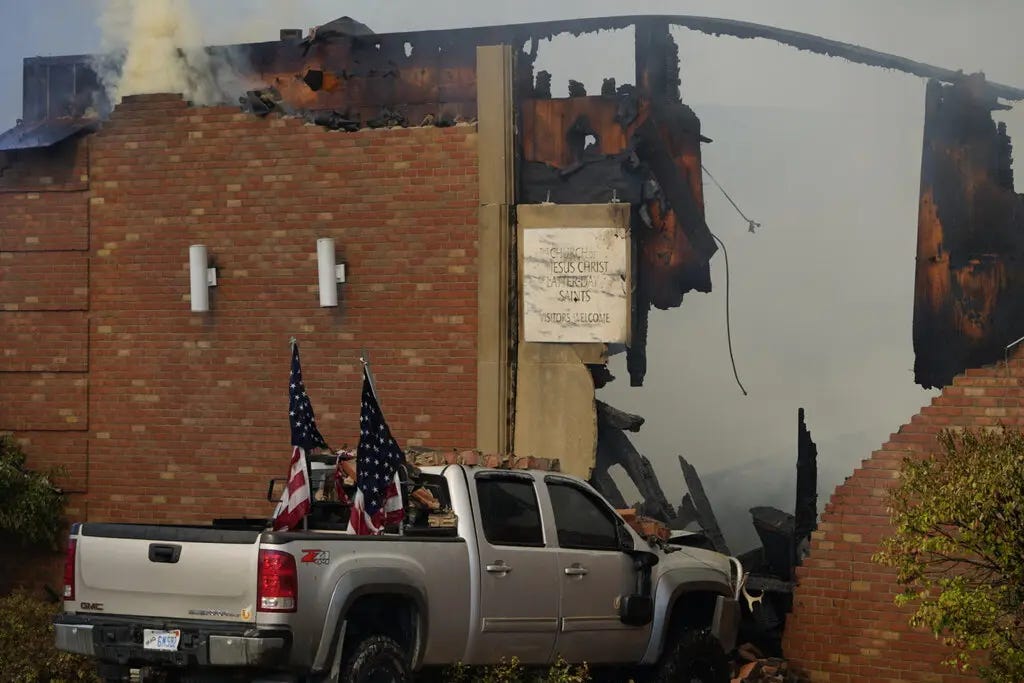
On Sunday, September 28, 2025, Grand Blanc, Michigan became the latest epicenter of American violence. A sanctuary, a place where prayers rose, where children learned hymns, where elders clasped hands in faith, was invaded by fire and gunfire. The attacker, 40-year-old Thomas Jacob Sanford, a former U.S. Marine, drove a pickup truck flying American flags into the church, opened fire with an assault rifle, and ignited the building with accelerants and by the time the smoke cleared, four lives were stolen and at least eight more wounded. The building itself collapsed into ash, declared a total loss. Police “neutralized” Sanford in a shootout only eight minutes after the first 911 call. His rampage was swift, deliberate, and devastating. Survivors describe screams drowned by gunfire, pews splintered into shrapnel, families clinging to one another as fire consumed what was once sacred ground.
We grieve with those who are grieving and refuse to normalize evil in our midst.
This line must anchor us, because we know what happens when evil is normalized. We have seen it before: we are seeing it in our own government in ‘MERICA right now!
The Pattern of Terror
Sanford’s attack is not an isolated eruption of madness; it is part of a recognizable pattern. In Charleston, South Carolina, worshippers at Mother Emanuel AME Church were massacred by a white supremacist in 2015. In Pittsburgh, a synagogue became a site of slaughter in 2018. In Texas, mosques and synagogues alike have been targeted. The logic is always the same: a man steeped in grievance, sanctified by violent ideologies, armed with weapons meant for war, turns his rage against the vulnerable. The targets differ, but the pattern is shared: churches, synagogues, mosques, schools, spaces that are supposed to nurture life are transformed into graveyards. Sanford carried not only an AR-style weapon but also the symbolism of empire…two American flags flapping from his truck as if his massacre was a patriotic act. This was not random. It was the fusion of nationalism, militarism, and delusion into one violent body.
The Weight of History
To understand Grand Blanc, we cannot stop at Sanford. We must trace the roots. The United States was birthed with sanctuaries of violence. From the burning of Indigenous villages to the auction block of enslaved Africans, from Jim Crow lynchings to police shootings, the soil has been soaked with blood. The Constitution enshrined exclusion, and white supremacy sanctified it with scripture. Every time Black, Brown, Jewish, Muslim, queer, or immigrant communities carve out spaces of survival, empire has sought to destroy them. Hush harbors were raided. Maroon camps were hunted. Black Wall Street was bombed. Mother Emanuel was pierced with bullets. And now, Grand Blanc’s sanctuary has been reduced to ash. This is not coincidence. It is continuity.
The Psychology of Delusion
Delusion does not exist in isolation; it is cultivated, rehearsed, and rewarded. It thrives in a culture that sanctifies violence when it is white and criminalizes existence when it is Black or Brown. The tragedy in Grand Blanc makes this painfully clear. Sanford was never just a “madman,” though the news will insist on that word. His name was Thomas Jacob Sanford, a 40-year-old former U.S. Marine who once carried the flag abroad and then carried an assault rifle into a sanctuary at home. He drove his truck emblazoned with American flags into a church, doused the space with accelerants, and opened fire on parishioners before setting the sacred walls ablaze. Four people dead. Eight wounded. A sanctuary lost to smoke and ash and yet, almost immediately, the script began: neighbors remembered him as “a happy guy,” a man who loved sports, a soldier who had fallen on hard times. His biography became the frame, not his brutality. That is the psychology of delusion, the way whiteness reframes terror as tragedy when the terrorist looks like its sons. When Black bodies are slain, the script flips: “thug,” “bad man,” “he had a record,” “she shouldn’t have been there.” Trayvon Martin becomes a cautionary tale, not a child. George Floyd becomes pathology, not a man gasping for breath. Sandra Bland becomes an attitude problem, not a woman stolen from her family; but Sanford, who turned a sanctuary into a war zone, becomes a troubled veteran, a man remembered with compassion. This delusion is not new. In every age, empire finds ways to sentimentalize its own violence while demonizing the survival of the oppressed. It is what made slaveholders call themselves “Christian gentlemen” while branding human beings. It is what allowed white mobs to call lynching “justice” while posing for postcards with lynching pics to send to family. And it is what now allows a domestic terrorist to be painted as a broken patriot rather than named for what he was: a murderer baptized in the waters of empire’s lies.
Sanford carried more than bullets. He carried a theology of empire that tells men like him that they are saviors when they dominate. He carried a psychology of terror that tells them violence is virtue. He carried a nationalist myth that insists mass murder is righteous when done in the name of purity and the delusion is so deep that sanctuaries can burn, lives can be stolen, and still the narrative bends toward his humanity while erasing the sacredness of those he destroyed. This is why the psychology of delusion must be named for what it is: not mere confusion, but the deliberate protection of whiteness at all costs because until we strip away that mask, America will continue to mourn its killers while mocking the grief of its victims.
The Hypocrisy of Response
Already we hear it: “Thoughts and prayers.” Already we see the familiar cycle: vigils, hashtags, fleeting outrage but beneath the surface lies the hypocrisy. When Black communities are shot, their grief is criminalized. Trayvon Martin became a meme. George Floyd’s final breath became a debate. Michael Brown’s body lay in the street like discarded trash. When we grieve, we are mocked, surveilled, dismissed. Yet when men like Sanford or Charlie Kirk, figures steeped in racism, white supremacy, and violence fall, the world calls them martyrs. Statues are erected. Tributes are given. Jobs are lost for merely reposting their own words. This imbalance reveals the truth: American grief is racialized. Some lives are mourned as national tragedies; others are discarded as necessary casualties.
Ontological Terror in the Ashes
What makes Sanford’s violence so heavy is not just the lives lost, but the echoes it triggers in Black communities. It whispers the same old terror: your sanctuaries are not safe, your prayers are not shielded, your survival is never guaranteed. This is not paranoia. It is ontological terror, an assault on existence itself. It says: You do not belong. You can be erased. Even your sacred spaces can be set aflame, and yet, even here, we must remember: survival has always been our counter-testimony. The fact that Black people still gather, still pray, still create sanctuaries, is itself defiance.
Betrayal from Within
One of the deepest wounds is betrayal. In slavery, preachers were handpicked to tell the enslaved to obey their masters. In Jim Crow, leaders counseled patience while people bled. Today, politicians like Hakeem Jeffries echo empire’s voice, disciplining dissent and silencing prophetic fire. This betrayal is not just political; it is psychological violence. It makes us doubt ourselves, question whether our grief or rage is legitimate. It teaches us to internalize exclusion but every time leaders like Jasmine Crockett declare, “I belong anywhere decisions are being made about our democracy,” they pierce through the betrayal. They remind us that legitimacy cannot be given by empire, it must be claimed by the people.
Doubt as Resistance
What sustains myths like the rapture or the sanctity of guns is fear. Fear that if people stop believing, the empire will lose its hold. Fear that if its idols are questioned, the system will collapse under its own contradictions, but every failed prophecy, every massacre, every unfulfilled promise of safety plants doubt and doubt, contrary to empire’s teaching, is not weakness. Doubt can be holy. This nation is addicted to the lie that more guns create more freedom, that stockpiles equal safety. Yet the evidence is plain: seventy percent of violent gun crimes in the United States are committed by white men. Seventy percent. And still, no one drafts legislation to restrict their access to firearms. Instead, every mass shooting is met with silence, excuses, or new laws targeting the already marginalized. Trans people are scapegoated, immigrants are criminalized, Black communities are policed, all while the real architects of violence are shielded by the very government that claims to protect us. This is where doubt must turn to resistance. We must call Congress to account: why are we not making gun control the urgent moral issue of our time? Why are we still pretending that the violence in this country comes from everywhere except where it actually comes from? Why is the shooter always “troubled” when he is white, but “thug” when he is Black? Why is the gun always freedom in white hands, but menace in Black ones? These are not rhetorical questions. They are indictments. They are the cracks in the wall of empire’s delusion and into those cracks, resistance must grow. Faith communities cannot hide behind empty prayers while their sanctuaries are turned into shooting galleries. Every pulpit that says “thoughts and prayers” without saying “policy and change” is complicit in the slaughter. Doubt here becomes holy: doubt in the idolatry of guns, doubt in the theology that baptizes weapons as divine rights.
Therapists and healers, too, must join in the resistance, naming clearly the trauma that gun culture inflicts on bodies and psyches alike. We see the anxiety in children doing active shooter drills. We hear the grief in families who bury loved ones while Congress takes donations from the gun lobby. We witness the deep wound of living in a land where safety is sacrificed for profit. To name this trauma is not political, it is ethical, it is survival and activists, from the streets to the schools to the digital spaces, must keep building communities of refusal. Refusal to accept white men as the perpetual “lone wolves.” Refusal to let marginalized communities shoulder the blame for violence they did not create. Refusal to let our grief be mocked or our rage be silenced. When we ask why sanctuaries burn, when we ask why freedom is always deferred, when we ask why lawmakers would rather regulate wombs and bathrooms than the assault rifles mowing down our children, we are not betraying faith, we are refusing delusion. Doubt is the doorway through which truth walks. Doubt is the crack in the wall through which liberation can grow, and, in that growth, we discover a new kind of faith: not faith in fantasy, but faith in ourselves, in our ability to resist, to grieve honestly, to legislate wisely, and to love fiercely enough to say: the violence must end here.
Black Survival Beyond Fire
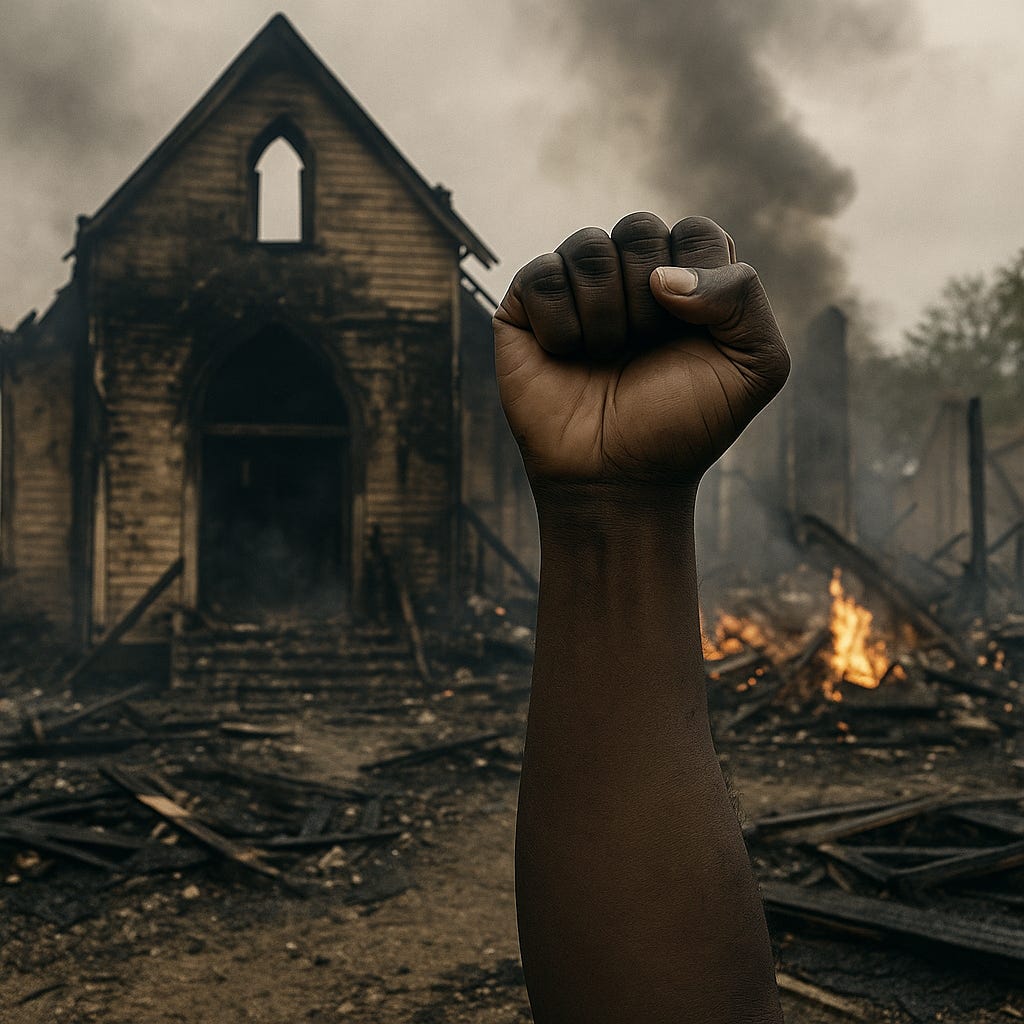
For Black communities, survival has never been about waiting for deliverance from those who enslaved or despised us. Survival was forged in the crucible of empire’s contempt. When chains were clamped on wrists and ankles, we made pathways toward freedom, through rivers, swamps, and secret codes sewn into quilts and hair. When silence was forced on our tongues, we created songs that carried across cotton fields and city streets, songs that spoke of sorrow and hope in the same breath. When erasure was written into the laws, the textbooks, the census rolls, we carved memory into our stories, into the names of our children, into the rhythms of drums that empire could not silence and created language that defied those who would have us gagged and bound for reading to teach others what we have learned. Our endurance has never been about escaping this world but transforming it underfoot (Jeremiah 29: 7; Romans 12: 2). In the hidden clearings where enslaved people gathered to pray away from the overseer’s gaze, whispering their grief into the night sky until it turned into power. In the maroon communities that claimed wilderness as homeland, declaring that even the swamps would conspire for Black freedom. In freedom schools where children learned the history empire outlawed, and in classrooms today where teachers risk their jobs to tell the truth. In the music that carried us from spirituals to blues to gospel to hip-hop, where every beat became both lament and uprising, a refusal to let grief have the last word. Each generation has found its own survival ritual. A raised fist when the world demanded bowed heads. A march through streets that had been designed for our exclusion. A sermon spoken with trembling voice but unwavering conviction. A vote cast even when voter suppression tried to make it impossible. A sanctuary rebuilt from ashes to proclaim that faith still lives here. These acts, large and small, become our declaration that belonging is not something given by empire but something we claim by existing in full, unashamed, and unbroken. We survive not because America ever meant for us to, but because we refused to accept death as our only inheritance. Our belonging is not conditional. It is not a gift. It is our truth, carved into history, sung into tomorrow.
Toward a Different Future
“A community mourns, a nation trembles, and the work of justice begins.”
The question is whether we will rise from these ashes with courage or collapse again into delusion. Grand Blanc’s sanctuary is gone, but its people remain, and their survival must become prophecy: not that evil will never strike again, but that solidarity will always rise stronger. This is not just about one church in Michigan. It is about America itself. Will we continue to sanctify guns as freedom? Will we continue to excuse white male violence as aberration while criminalizing Black grief? Or will we finally admit the truth, that the real terrorists have always been homegrown, and that justice demands not thoughts and prayers but transformation?
What Will You Do?
The rapture will not come. The clouds will not split open to spirit us away from empire’s violence. The Church’s obsession with escape, its sickness of longing to be lifted out of the fire rather than confronting the blaze, has numbed generations into passivity. Waiting for heaven has excused neglect on earth but the only deliverance that will ever matter is the deliverance we labor for together, with our hands, our memory, and our solidarity. The sanctuary may lie in ash, but the people are not consumed. They will gather again, not to wait for wings, but to build something new. They will sing again, not for escape, but for strength. They will resist again, not for fantasy, but for freedom and in that refusal to abandon the earth, prophecy is fulfilled. Grand Blanc is proof of this. A holy place was set on fire, lives were stolen, trauma was inflicted and yet the community refuses to vanish. Four parishioners will not return home to their families, eight more carry wounds in their bodies and spirits, and countless others will carry the scars of witnessing terror where they once sought refuge but their lives, their love, and their names will not dissolve into the smoke. They remain testimony that the work of justice is not optional, that sanctuaries must be guarded not only by walls but by collective courage, that memory itself can become a weapon against erasure and the survivors who gather in parking lots, in borrowed spaces, in living rooms, proclaim something empire cannot: We will not wait for escape. We will build what you tried to burn. To choose rebuilding over resignation is to reject rapture-sickness itself. Every hammer lifted, every hymn raised, every tear turned into action is a refusal to be erased. Black people have always known this truth: the only rapture worth believing in is the one we create together, with our feet planted firmly in the soil of struggle and our hearts lifted toward the freedom we build.
